Uma Semana Decisiva
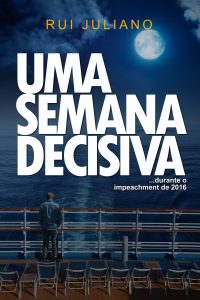
Sinopse:
Léo é um homem do tempo atual, com sessenta anos, leva vida saudável, se cuida, está solteiro depois de dois casamentos, porém se divertiu muito na vida. O personagem principal faz um cruzeiro por cinco cidades do Mediterrâneo Oriental, durante uma semana que será importante para ele, para os demais personagens da obra e os da vida real da história recente do Brasil.
Na semana decisiva de 2016, o Brasil passa por um dos momentos mais dramáticos e decisivos da política contemporânea. Nela é decidido o passo mais importante para o impeachment de Dilma Rouseff, em cenário da Lava Jato.
A trama permite mostrar o marxismo cultural, a partir do golpe de 1964, e o nascimento da nova direita, de 2013, a partir de notícias da vida real daquela semana, além de discussões sobre as bandeiras da esquerda: racismo, homofobia e feminismo.
Léo tem problemas naturais de idade e tormento afetivo interior, os quais deverão ser resolvidos por ele para que alcance a mulher com que poderá viver o resto de sua vida, enquanto contempla o turbilhão de acontecimentos na esteira de borbulhas das hélices do navio.
A raridade deste romance está no fato que é escrito com viés de tendência política de centro ou de direita, já que é difícil encontrar escritor de ficção que não seja de esquerda com o consequente direcionamento de seus pensamentos nas obras que escrevem.
Autor: Rui Juliano
ISBN: 978-85-904919-3-4
3 books to know: London
Autor: Charles Dickens, Daniel Defoe, Woolf,Virginia, Charles Dickens, Daniel Defoe, August Nemo
Sinópse: Welcome to the 3 Books To Know series, our idea is to help readers learn about fascinating topics through three essential and relevant books.These carefully selected works can be fiction, non-fiction, historical documents or even biographies.We will always select for you three great works to instigate your mind, this time the topic is: London. Great Expectations by Charles Dickens.Mrs. Dalloway by Virginia Woolf.A Journal of the Plague Year by Daniel Defoe.Great Expectations is the thirteenth novel by Charles Dickens and his penultimate completed novel: a bildungsroman that depicts the personal growth and personal development of an orphan nicknamed Pip. It is Dickens’s second novel to be fully narrated in the first person.The novel is set in Kent and London in the early to mid-19th century and contains some of Dickens’s most memorable scenes, including the opening in a graveyard, where the young Pip is accosted by the escaped convict, Abel Magwitch. Great Expectations is full of extreme imagery—poverty, prison ships and chains, and fights to the death—and has a colourful cast of characters who have entered popular culture.Upon its release, the novel received near universal acclaim.Although Dickens’s contemporary Thomas Carlyle referred to it disparagingly as that “Pip nonsense,” he nevertheless reacted to each fresh instalment with “roars of laughter.” Later, George Bernard Shaw praised the novel, as “All of one piece and consistently truthful.”Mrs. Dalloway is a novel by Virginia Woolf that details a day in the life of Clarissa Dalloway, a fictional high-society woman in post–First World War England. It is one of Woolf’s best-known novels. Created from two short stories, “Mrs Dalloway in Bond Street” and the unfinished “The Prime Minister,” the novel addresses Clarissa’s preparations for a party she will host that evening.With an interior perspective, the story travels forward and back in time and in and out of the characters’ minds to construct an image of Clarissa’s life and of the inter-war social structure. In October 2005, Mrs Dalloway was included on Time’s list of the 100 best English-language novels written since 1923.A Journal of the Plague Year is a novel by Daniel Defoe, first published in March 1722. This novel is an account of one man’s experiences of the year 1665, in which the Great Plague or the bubonic plague struck the city of London. The book is told somewhat chronologically, though without sections or chapter headings. Presented as an eyewitness account of the events at the time, it was written in the years just prior to the book’s first publication in March 1722. Defoe was only five years old in 1665, and the book itself was published under the initials H. F. and is probably based on the journals of Defoe’s uncle, Henry Foe.In the book, Defoe goes to great pains to achieve an effect of verisimilitude, identifying specific neighborhoods, streets, and even houses in which events took place. Additionally, it provides tables of casualty figures and discusses the credibility of various accounts and anecdotes received by the narrator.This is one of many books in the series 3 Books To Know. If you liked this book, look for the other titles in the series, we are sure you will like some of the topics
ISBN: Não informado
Todos os direitos reservados – 2019 – Rui Juliano